
The Music Community of Victorian Worcester
Written by Albert Edward Bibbs
Mr. W.C. Box was an active supportive of the Union: and wrote some music for it.
After the retirement of Mr. E.J. Spark, Mr. Stanley James assumed the conductorship, but after his death some years later, the Vocal Union went the way of all flesh, and its members were scattered. During Mr. James' tenure as conductor, the Union gave many delightful concerts in the grounds of the Barbourne Bowling Club, which gave rise to the singers being known as the 'Barbourne Littets', and surely linnets never sang more sweetly.
The valuable collection of glees and part songs passed on to the possession of the late Mr. George Blandford, in whose family I presume they still remain. Why cannot Worcester emulate the sister City of Gloucester, and have its own Male Voice Society? Talking to the late Andrew Black on one occasion, I asked him what class of vocal music gave him the greatest pleasure? "Why," he said, "glee singing, by all means." And as W.S. Gilbert would say, "A good judge too."
Naturally, as a young man, I was desirous of joining the chief Choral Society, known as the Worcester Philharmonic Society, which in time became the Worcester Festival Choral Society. This I joined in 1884. Mr. W. Done was of course the conductor, and Mr. A.R. Quarterman accompanist. Mr. John Grainger was Treasurer, to be succeeded shortly afterwards by Mr. H.A. Leicester. Mr. Charles Jones, Librarian. Mr. H.W. Littlw was then, and for some years afterwards, Hon. Secretary, to be followed in turn by Mr. J.W. Somerton and myself. Apart from the usual concerts, the Society (as now) provided the nucleus for the Worcester contingent of the Three Choir Festivals.
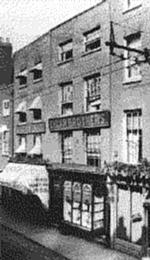
The Elgar's Shop at 10 High Street
The year of my first engagement... 1884... was notable for the production for the first time at these Festivals of Dvoraks "Stabat Mater", with Madam Albani, Madam Patey, Mr. Edward Lloyd, and Mr. Charles Santley as soloists, and what a quartet this was! Dvorak was not successful as a conductor, and subsequent performances of this work was much improved on.
Dvorak was a striking looking man, very short and thickly built, swarthy of complexion, and having a massive head... The contrast between him and his interpretor, Mr. Littleton, who was over six feet tall, and very thin, was remarkable, as they walked along the High Street.
Written by Albert Edward Bibbs
Mr. W.C. Box was an active supportive of the Union: and wrote some music for it.After the retirement of Mr. E.J. Spark, Mr. Stanley James assumed the conductorship, but after his death some years later, the Vocal Union went the way of all flesh, and its members were scattered. During Mr. James' tenure as conductor, the Union gave many delightful concerts in the grounds of the Barbourne Bowling Club, which gave rise to the singers being known as the 'Barbourne Littets', and surely linnets never sang more sweetly.
The valuable collection of glees and part songs passed on to the possession of the late Mr. George Blandford, in whose family I presume they still remain. Why cannot Worcester emulate the sister City of Gloucester, and have its own Male Voice Society? Talking to the late Andrew Black on one occasion, I asked him what class of vocal music gave him the greatest pleasure? "Why," he said, "glee singing, by all means." And as W.S. Gilbert would say, "A good judge too."
Naturally, as a young man, I was desirous of joining the chief Choral Society, known as the Worcester Philharmonic Society, which in time became the Worcester Festival Choral Society. This I joined in 1884. Mr. W. Done was of course the conductor, and Mr. A.R. Quarterman accompanist. Mr. John Grainger was Treasurer, to be succeeded shortly afterwards by Mr. H.A. Leicester. Mr. Charles Jones, Librarian. Mr. H.W. Littlw was then, and for some years afterwards, Hon. Secretary, to be followed in turn by Mr. J.W. Somerton and myself. Apart from the usual concerts, the Society (as now) provided the nucleus for the Worcester contingent of the Three Choir Festivals.
The Elgar's Shop at 10 High Street
The year of my first engagement... 1884... was notable for the production for the first time at these Festivals of Dvoraks "Stabat Mater", with Madam Albani, Madam Patey, Mr. Edward Lloyd, and Mr. Charles Santley as soloists, and what a quartet this was! Dvorak was not successful as a conductor, and subsequent performances of this work was much improved on.
Dvorak was a striking looking man, very short and thickly built, swarthy of complexion, and having a massive head... The contrast between him and his interpretor, Mr. Littleton, who was over six feet tall, and very thin, was remarkable, as they walked along the High Street.